
🦋 20. When Something Long Buried Begins to Stir
A celebrated ballerina speaks of the life beneath the glamour. Later that night, someone she has carried quietly for half a century rises from the past...

Previously in Evangeline’s story…
Evangeline Hart had never painted a portrait of consequence. Her cousin. Her mother. A friend from university. That was the entirety of her portrait list.
Then Alexander Moreau — London financier, art collector, and quiet lover of beautiful things — had come across her work and asked whether she might consider a commission. It was for a dear friend, he explained. Someone for whom ordinary gifts were rather difficult.
She had said yes.
Only afterwards had she discovered who the friend was: Madame Margaux Vasiliev — one of the most celebrated prima ballerinas of the late twentieth century, now in her seventies and recently returned to London after many years in Europe.
Evangeline had spent a fortnight reading everything she could find about the great dancer before finally travelling to Number 47, Eaton Square, to meet her.
Margaux had been more radiant in person than any photograph had prepared her for: contained, deeply private, gracious, and disarmingly direct.
“I have been painted before,” she had said. “None of them, I think, have ever quite shown me.”
Evangeline had proposed three pencil sittings before committing anything to paint, with the understanding that if the sketches were unsatisfactory, Margaux would be under no obligation to proceed with the portrait.
Margaux had accepted.
They had agreed to begin on Friday.
Today was Friday.
The story continues:
Evangeline hadn’t told anyone where she was going.
It had not been difficult to arrange. She had organised a ‘work from home’ day with her boss. On the home front mentioning only that she had “a few errands to run” — a phrase vague enough to mean anything, or nothing. Scott had barely looked up. He had his own Friday, full of its own urgencies, and the question of how his wife spent hers had not, for a long time now, been one that interested him.
Today she was glad of it.
Because if this went badly — if she sat down with her pencil and pad in the beautiful Georgian home of this celebrated prima ballerina and found that the portrait she had promised Margaux was beyond her, if Margaux’s careful eyes came to rest on the sketches and found them unsatisfactory — then she wanted to absorb that privately. She wanted to be able to fail, if she was going to fail, without an audience. Without the humiliation of having to explain, over dinner, that she hadn’t been up to the great opportunity and it had come to nothing. She could endure the defeat, if it came. But she wanted to endure it in private.
So, she told no one. She simply gathered her bag — the good sketchbook, the pencils, the kneaded eraser — and let herself out of the quiet house, and made her way, for the second time, to number 47, Eaton Square.
Marie opened the door before she had quite reached the top step.
“Ms Hart. Good morning.” A small smile — warmer, this time, than the first. “Madame is expecting you. She’s in the library. Do come through.”
The library.
Evangeline stepped into the hall, the chequerboard marble flooring, the huge brass lantern overhead, the fresh flowers on the round mahogany table — all of it was more familiar now. She noticed things she had missed on her first visit. A small bronze figure on a side table, a dancer caught mid-turn. A watercolour of a theatre interior, gilded boxes rising into shadow.
Marie took her coat and led her not to the drawing room this time, but along the hall and up half a flight, to a door that stood ajar.
“Madame — Ms Hart is here.”
“Send her in, Marie. Thank you.”
Evangeline stepped into the room.
This room she realised had an entirely different feeling to the formality and composure of the drawing room from her previous visit. This room was lived in.
Facing her as she entered was a tall Georgian bay window overlooking the gardens letting in a clear, even northern light. A broad walnut desk nestled into the window, held fresh flowers, neatly arranged stationery alongside an open laptop, and a brass swing-arm lamp. A soft linen, button-tufted office chair inviting the occupant to sit.
Two walls were fully lined with shelves, painted a soft taupe with cream accents, rising from floor to ceiling, small paintings and picture-lights mounted here and there along the uprights, throwing pools of warm light across the shelves crowded with books - novels, biographies, poetry, theatre, history, and art books with their larger spines arranged along the lower shelves; giving the immediate impression of its mistress being an avid reader with clearly a curious mind.
Margaux was standing by the window, looking out at the gardens, she turned as Evangeline came in.
“Good morning.”
She was dressed more simply today — soft, wide charcoal trousers, a pale grey cashmere jumper, the pearls again, the imperial topaz ring. Her white hair loose but still somehow effortlessly styled. She looked, if anything, more beautiful in the plain morning light of this smaller room than she had in the grandeur of the drawing room. There was nothing to compete with her here. Only the books, and the light, and the woman.
“Good morning, Margaux.”
A small nod, and a gentle smile.
“I thought we might sit in here, if it suits you.” Margaux gestured at the room, lightly. “The drawing room is very fine, but it is not — how shall I say — it is not where I am. And you told me, at our first meeting, that you would not paint merely the surface.” A faint, dry warmth. “So. Here is beneath the surface.”
Evangeline smiled.
“It’s a beautiful room.”
“It is the only room in the house I would not let a decorator touch. Everything else, they arranged, but this is my favourite room.”
“I felt it as I came in.”
Margaux looked at her, and something passed behind the deep blue eyes — a small registration - “Yes,” she said. “I thought you might.” She was pleased with Evangeline’s recognition.
With the sweep of her elegant, outstretched hand, Margaux motioned for them to sit by the warmth of the lit fireplace, where two high backed, soft armchairs, upholstered in a finely woven botanical fabric of lichen green, old gold, tobacco and the palest antique rose sat facing each other; low pile carpet underfoot and a freshly brewed pot of tea with almond biscuits waiting on the coffee table was positioned between them.
As she sat down, Evangeline realised this was possibly one of the most comfortable chairs she’d ever encountered.
She did not begin at once.
She put her sketchbook on her lap but did not open it. Sitting opposite Margaux, Evangeline could feel her nerves rising in her chest; she now felt the full weight of the expectation, and of the portrait she somehow had to bring to life.
Start too quickly, her instinct told her, and you will begin with a shaking hand and a mind that was still preoccupied with the situation at hand and had not yet settled into focus.
Looking towards the bookshelves opposite her, in an effort to break the ice and steady herself, Evangeline said, “I can see you are an avid reader.”
“Yes,” Margaux said. “Always. Ever since I was a young girl.”
She looked, for a moment, at the shelves.
“A good book is the great companion of a life, I think. It asks nothing of you, and yet it gives you everything — company, escape, adventure, a character to sit with, a place to be, the ability to travel to another time. No matter where I have been in the world, or what has been happening in my life, if I have had a good book with me, I have always been, in some quiet way, all right.”
She glanced back at Evangeline.
“And it was of enormous use to me in my career. People imagine a dancer’s life is all movement — the stage, the lights, the applause. It is not. It is waiting. Hours and hours of waiting, every day — while the répétiteur, the person responsible for rehearsing and coaching us in our roles, finished with another cast. While the choreographer decided whether he wanted the corps to run the second act again, or whether he was finally ready for me. For a costume fitting. For a photographer. For the physiotherapist. For a partner to be treated after an injury. For a lighting problem to be solved in the theatre. For the afternoon rehearsal to begin. And, when we were travelling, in airports and railway stations and hotel rooms in cities I barely had time to see.”
A small, dry smile touched her mouth.
“Some dancers found the waiting difficult. I did not. Books were a balm to me. They fed the part of my mind that had always been curious and allowed me to read my way through all of it.”
Evangeline hesitated.
“May I ask you something?”
“Of course.”
“When you say that…” Evangeline glanced towards the shelves, then back at Margaux. “What was it really like? At the height of it all. Not what people imagine from the photographs, or the stage, or the flowers afterwards. But your actual life. A day in it.”
“You mean when I was dancing?”
“Yes. When you were at the very centre of it.”
Margaux gave a small smile as she considered the question.
“People tend to think it was all tulle, make-up and applause.”
“It was beautiful,” she said. “I do not want to pretend otherwise. There were costumes that took one’s breath away. There were theatres so magnificent that, standing in the wings before a performance, one could feel the whole history of the place pressing gently against one’s back. There were evenings when the orchestra began and the curtain rose, and for two hours one entered a world more magical than ordinary life could ever be.”
She paused.
“But that was the visible part. The life itself was much less romantic. It began each morning with class, no matter what had happened the night before. Even when one had performed until late. Even when one’s feet were blistered and bleeding, or one’s back was stiff, or one had slept badly. You stood at the barre and began again — pliés, stretches, the exacting work of placing the feet and aligning the body, persuading it to become obedient.
“Then came the work itself. A single passage might be rehearsed until the music no longer sounded like music, only something against which one measured the movements of one’s own body. With one’s partner: lifts, timing, catches, entrances, exits, the exact line of a hand on a shoulder. Then a variation, refined again and again with the répétiteur until a turn found its balance, a leg reached precisely where it ought to be, and nothing appeared to have cost any effort at all.”
“The costumes were beautiful, yes. But they could also be heavy, hot, restrictive. A skirt might catch in a lift. A bodice might make it difficult to breathe properly. A sleeve might stop the arm from reaching where it needed to go. By then I had enough standing to say, ‘This will not work,’ and someone would alter it. But one did not choose the costume simply because it pleased one. It belonged to the ballet. My task was to make it disappear — to make the audience believe I had been born in it.”
She looked down at her hands.
“And then, once the production opened, everything became about preservation. Eating properly. Resting when one could. Treatment. Ice. Massage. Keeping one’s mind calm. Returning to the theatre early enough to warm up, prepare one’s shoes, dress, breathe, and find the stillness and concentration required before the curtain rose. Afterwards there were flowers and applause and people waiting at the stage door. But by then, usually, all I wanted was to take off my shoes and go home.”
Her expression softened slightly.
“It was a beautiful life. But it was a very disciplined one. The studio, the theatre, the dressing room, the hotel room, the apartment. Again and again. It asked a great deal of the body, and it asked even more of one’s attention.”
Evangeline began, at last, to sketch.
Loosely, without weight. She was not trying to make anything yet. She was simply looking — following the line of Margaux’s jaw, her shoulder into her neck, the turn of her head, the way her hands rested on the arms of the chair. Each mark on the paper was a small act of noticing.
“I’ll start now, if you don’t mind,” she said. “Just gestural. Nothing you’ll recognise if you glanced at it. I’m getting a feel.”
“Do as you need to.”
Evangeline sketched for a moment in silence, and then, without lifting her eyes from the page, she said:
“May I ask you a question?”
“You may.”
“What do you want this portrait to say? What do you want it to express?“
Margaux was quiet for so long that Evangeline nearly looked up. But she made herself keep drawing, letting the silence stretch, letting Margaux come to it in her own time.
“I have been thinking about that question,” Margaux said finally, “for weeks. Since the afternoon Alexander first spoke to me about the commission.
Margaux looked out toward the bay window for a moment, and then back.
“I want it to say,” she said, “that I have lived a full life. That I used every talent I was given, to the fullest of my ability. That in the beginning, that talent was the dancing — and I did not waste it. I gave it everything. It took me to the top of my profession and kept me there for a very long time.” A small breath. “That is the outside of the story, and I do not disdain it. It was a great thing.”
She paused.
“But I want the portrait to show that beneath this outside veneer — beneath the glamour, the applause, the success — there has always been a woman who is disciplined, resilient, who was not afraid to go after her dreams and knew her own mind. Who has never been intellectually still, not for one hour of her life. I want that woman visible.
Evangeline’s pencil had slowed.
“I want it to say that I have known real beauty— the music, the theatres, the painters, composers, choreographers, my fellow dancers I was fortunate enough to know, the extraordinary artisans who made the costumes and the sets; the friends who worked in the world of art. I have lived inside beauty, and among people who were making it, for fifty years. It was the great joy of my life. I want this portrait to project that - a woman who came from that.“
She was not looking at Evangeline now. She was looking somewhere else — into some further distance the room could not contain.
“And I want it to say that I have loved deeply, and I have known extraordinary love and profound loss. That my life was not spent on the surface.”
She was quiet.
She looked back at Evangeline, and her eyes were clear.
“That is the portrait I would like you to paint.”
Evangeline had been writing as Margaux spoke — small quick notes in the margin of her sketch page, phrases she wanted to keep. A serious mind. A woman who came from beauty. Loved deeply, known loss. Lived, truly lived. It was quite a lot to take in. She looked up now, meeting Margaux’s eyes.
“I understand,” she said quietly. “Thank you.”
Margaux inclined her head, the smallest fraction.
“You are welcome.”
They worked on quietly for the remaining half-hour or so, the tea and biscuits long finished on the coffee table. Evangeline had a dozen loose sketches by the end of it — hands, the turn of the head, the shoulders, the beginning of something in the eyes she thought, on the third attempt, she had almost caught. None of it was the painting. All of it was the beginning of the road toward the painting. It was enough for now.
The two hours had gone almost before she noticed them.
At ten past the hour Margaux glanced at the small clock on the mantel and said, dry as always:
“I believe we have both survived it.”
Evangeline laughed. “Yes”
“Friday next? Same time?”
“I’ll be here.”
Margaux walked her down to the hall herself, unhurried, and at the door she extended her hand, and then — as she had done the first time — briefly placed her other hand over Evangeline’s. This time she held it a moment longer.
“You are easy to talk to, Evangeline. I have enjoyed today and I look forward to seeing you next week.”
“It has been my pleasure.” Evangeline replied just as Marie appeared with her coat. A moment later she was on the pavement, the black door of Number 47 closing softly behind her.
She took a cab.
Sitting quietly in the back as it moved through the early-afternoon streets of Belgravia, her sketchbook on her lap, she felt — for the first time since Claire Marchand’s phone call three weeks earlier — that she was going to be able to do this.
She had good sketches. She had a direction. She had, in her margins, the shape of what Margaux wanted her portrait to say. She had two more sittings ahead in which to deepen all of it, and she felt, quietly and cleanly, that they were going to be enough.
I think I can actually do this, she thought, as she breathed out and let her body relax into the back seat of the cab.
At Number 47 that evening, the house had grown quiet.
The lamps in the hall had been left on low. Eaton Square was almost empty — a man walking a small dog, the ordinary hush of an expensive London street at ten o’clock at night.
Margaux was upstairs in her bedroom, in a soft ivory dressing gown, readying herself for bed. She had eaten a small supper while listening to a piece of Fauré. And now, sitting at her dressing table as she brushed her hair, her mind wandered— to the afternoon.
About the painter in her library. About the questions she had been asked. About the answers she had given, which had come out of her more easily than she had expected, and which had contained one or two things she had not said aloud in decades.
I have loved deeply. I have known extraordinary love.
Her mind, without her realising, began to drift.
Back — a long way back. To a dressing room at Covent Garden. To a girl of twenty-two, still with the flush of the second act on her cheeks, opening a small blue box that had been delivered unexpectedly just before she was due back on stage for the final act.
She sat for a moment with the memory. Then, quietly, putting down her hairbrush, she rose from the dressing table and crossed to the tall chest of drawers set against the far wall of her walk in wardrobe, and opened the top drawer.
Beneath several folded silk scarves lay a flat rectangular box. The distinct colour of duck-egg blue. The words Tiffany & Co. stamped in small letters on the lid. The cream ribbon from one of her slippers from that performance of so long ago, tied around it, the ribbon soft with age.
She did something she had not done for quite some years – she untied the ribbon, and carefully opened the box.
It lay in a thin sleeve of the finest cream silk, nestled within the matching padded satin interior of the box, lifting it, she slid it out of the sleeve — gently, unhurriedly.
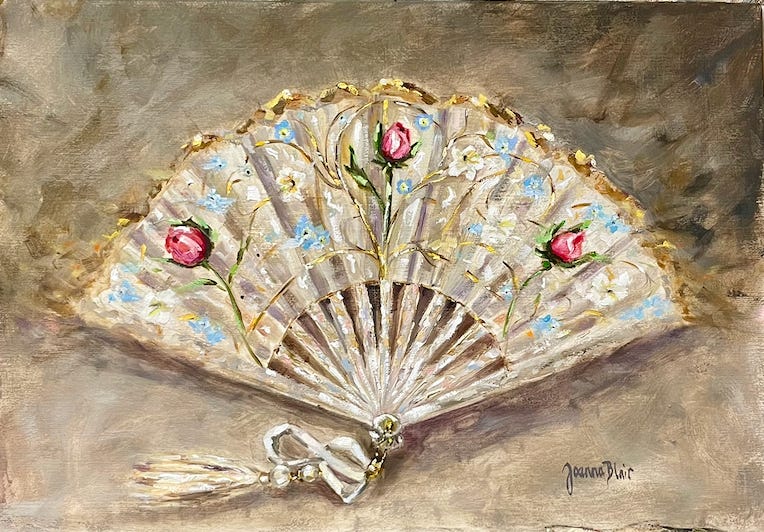
The fan was exquisite. Custom-made by Tiffany & Co., its sticks were of mother-of-pearl, carved fine as lace and gilded along their edges. Its leaf was of hand-painted silk gauze, embroidered with deep pink rosebuds, sprays of orange blossom and a scattering of forget-me-nots in the softest faded blue, the whole threaded through with fine gold. A silk tassel hung from the guard, and just above it sat a single flawless natural pearl, glowing delicately in the light of the dressing-table lamp like a perfect full moon.
She held it a moment. Then, carefully, she opened it fully.
The lamp caught it as it unfurled — the gold threads glinting along the length of the leaf, catching the light in tiny points of fire, the soft glistening of the mother-of-pearl sticks, the sheen of the embroidered flowers, the pearl at the base gathering the room’s soft glow into itself and reflecting it back. The fan itself thoroughly luminous. Even after fifty years, it still beguiled her.
She lifted it and moved it gently back and forth, close to her face.
The scent rose from the silk — warm, leathered, deep, unmistakably masculine. It had barely weakened over half a century. Protected by the cream silk and the closed box, the fragrance had held: not quite as it had been, perhaps, but near enough to make the years between them suddenly fall away.
As she gently fanned herself, she closed her eyes and took a deep breath — the scent now beginning to swirl around her.
And then…he was there.
Not as a memory, exactly. Memory was too gentle a word for it. This was more immediate. The sensation struck her viscerally, a place that was inner and sacred, sending a thrill through her body, as he had done so long ago.
For one suspended moment, he was no longer a man she had loved five decades before. He was simply there.
Young still. Exactly as he had been. Handsome, strong, sensual, brimming with vitality and life.
And in the quiet of her room, she sensed him standing behind her, one hand resting lightly on her shoulder. She could almost feel the warmth of it through the silk of her dressing gown. Could smell him. Could hear, almost, the low, steady voice she had loved beyond all reason.
Her eyes still closed.
The fan rested half-open on her lap, and the years fell away as she sat with him.
After a while, she opened them again.
Inside the box, beneath the empty sleeve of cream silk, lay the small rectangle of pale card.
His handwriting had been unmistakable — elegant, decisive, the dark slant of the letters as familiar to her once as the shape of his mouth, the sound of his voice, his breath on the back of her neck.
She had not needed to read those words in years.
They had been etched upon her heart from the moment she first read them.
Slowly, almost reverently, she reached for the card.
And for the first time in a very long while, Margaux Vasiliev allowed herself to remember a love that was the one love that reached the very centre of her. The one she never replaced. The one she carried quietly, and privately, for fifty years…
📖 Missed the previous instalment? → click here
📘 The next instalment arrives in a fortnight — stay tuned…